Your most brilliant expert might be your worst teacher
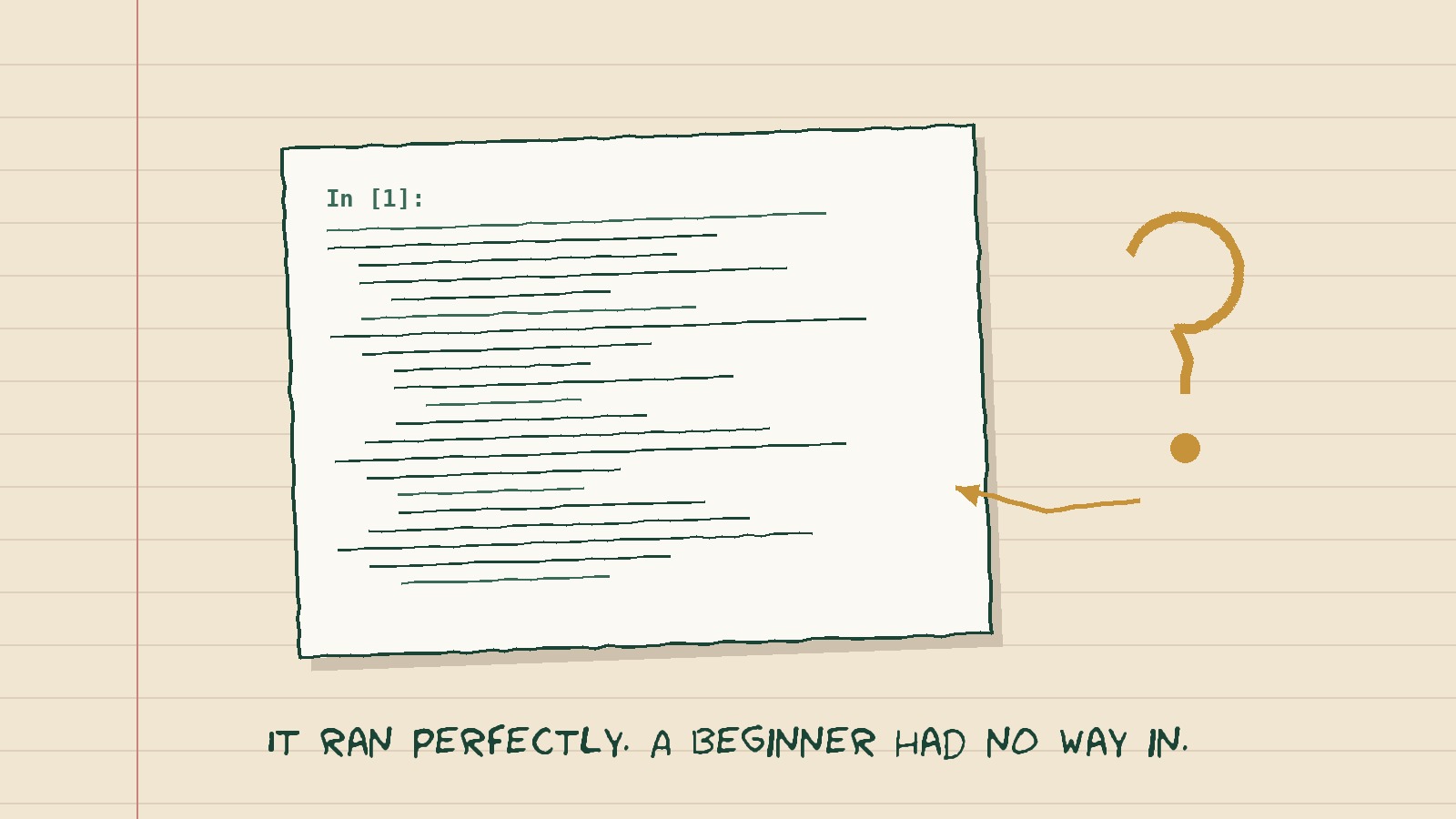
The first lesson came back as a notebook full of Python.
This was the AI for Healthcare course at Udacity, and our subject matter expert was doing this work for real in his day job, so the notebook looked like what he actually did all week. Libraries stacked up, electronic health records getting pulled apart and processed, all of it running. My first reaction was that this was incredibly cool, and my second was that a student opening it up would have no idea what they were looking at.
I wasn't an AI or healthcare expert, and I was hesitant about being the person who helped build this, but it turned out I didn't need to be either one of those things. I had enough background to read the code and follow what it was doing, and what the lesson needed was somebody asking the questions he had stopped needing to ask himself. How do you get from this part of the code to the next one? What does a student need to already know before this part makes any sense to them?
He could do this work in his sleep, which is exactly why it was hard for him to teach, because the reasoning had gone automatic somewhere along the way and so it never made it onto the page. Most of what I did on that lesson was getting the instructor to say the parts he had quit noticing he knew, and then I rewrote a fair amount of it anyway, the content and the questions and some of the code, all of it reshaped so somebody new to this had a way in.
Don't get me wrong, some of the best experts I've worked with are also great teachers. They can lead their field and break down a hard problem to help somebody understand how the concepts fit together, so that person can go apply that knowledge too. But a lot of experts, and I'd include myself in this, sometimes forget that we have an expert bias. We forget how much we learned along the way to get here, and that breaking the problem back down is its own thing we have to learn in order for a student to get anything out of it.
We've all sat in a college version of this, where you listen to a genuinely impassioned speaker who is super engaging and still walk away at the end of the semester unable to apply any of it in a real way. Our job in education is to take that and distill it down into applicable skills a student can practice and walk away with.
One thing I didn't expect was that the instructor got better at this with each lesson we completed. And while it cost real time on the build, the last lesson was much better than the first, with far less rework, and that instructor now had skills he never had before, too.
That lesson ended up becoming the template for the rest of them, so the next person had something to work from instead of starting cold. We also quit asking experts to do the breakdown on their own. Every one of them got paired with somebody whose whole job was that translation, where the expert brought the knowledge and the other person worked out how a beginner climbs into it, and that pairing is how we grew the instructor pool about tenfold without watching quality slide.
If you're the one getting brought in as the expert, try turning those questions on yourself before somebody else has to. How did I get from this step to the next one, and what did I already know that let me make that jump? That's harder to answer than it sounds once you've been good at something for years, and I still don't know how much of it you can teach an expert versus how much you have to build around them. If you've figured out where that line sits, I'd like to hear it.